Tuesday, March 8, 2016

Case Study Week #10 Telehealth Work Center


Telehealth

                                                             
A newly hired registered Nurse (RN) is assigned to work at the telehealth work center.  The RN is monitoring the in coming data from home-bound (based) patients from around the county, checking to see if there are any situations which require nursing interventions and taking the appropriate actions. One (1) patient is a type II diabetic. He reports his fasting blood sugar level of 54. Another patient who has congestive heart failure (CHF) and regularly reports in on daily basis does not send in any information (data).

  • What is the best course of action for the RN to take regarding the diabetic patient?

    • Assessing for symptoms
    • Was any insulin administered prior to this result
    • Have patient eat 15-20 grams of glucose or simple carbs to increase blood glucose
    • Have him then recheck the blood sugar and provide updated information
    • Advise small snack if he isn't going to eat within the next couple of hours.  
    • What are normal parameters for this patient
    • Diet history
    • Follow up with diabetic education and nutrition information


  • How should the RN proceed regarding the lack of information from the CHF patient ?  
                                             
    • Contact the CHF patient
    • If can't reach patient, contact emergency contact person
    • Determine if this is an emergency situation or just a mistake in reporting from the patient
    • Follow protocol for facility if this is an emergency

Telehealth: The Future of Medicine

Hmmmmmmmm.......................


Monday, March 7, 2016

                            
One of our responsibilities on the floor is to reconcile the patient's Medication Record in the chart with the Electronic Medical Record of medications in the computer. It is the nurses responsibility to ensure that what the patient and doctor have concluded as being the patient's actual medication, route of delivery, dose, and reasoning for taking is accurate. So, questions.......


1. Does the use of the Electronic Medical Record guarantee error-free patient care?

I say there is really never 'guarantee' when the human element is added to anything. However, by using this double check, there is the opportunity to catch any human errors that may have occurred. I have personally caught errors when reviewing this document. It is usually an error of entry into the computer by the pharmacy or a deciphering error of the written record. There is clearly an improved opportunity to provide the best quality care for patient's medication records by using an electronic system that is double checked by the nurse. Just take into consideration that where there is the human element, there is always a possibility for error.


2. What types of nursing behavior regarding the use of Electronic Medical Record's might contribute to jeopardizing patient safety?

I would say that error in relation to the human element includes occurrences involving interpretation of hand written orders by secretaries and nurses, not to mention the doctor who wrote the order. The alertness of the nurse. Shortages of nurses and/or under staffing can emerge in nurses who are tired. Also, nurses can become overwhelmed with duties and may tend to rush through tasks. There is always a good chance of error when rushing on the job. Lastly, if there is a way to short cut the procedure, some nurses may take advantage of that and skip steps or even just note the medication record assuming it is correct without really reviewing it. These are all ways that may contribute to patient safety with regard to medications.
                                             

3. What are the dangers of excessive system alerts in computer charting systems?

I think the number one danger of excessive system alerts is they become so common place that they are skipped over or not taken seriously. It's a matter of, "oh there is that message again, just hit escape and move on". Nurses are moving fast from the moment they come on shift. They hit the floor running and don't stop for at least 12 hours. Excessive system alerts can get in the way and nurses can become really skilled at finding ways around them.


4. How can the nurse guard against the potential effect?

The best way to ensure you're doing a good job as a nurse and providing excellent patient care and safety is to slow down, pay attention and do your best. I have found this to be true as a new nurse. I have felt on several occasions that going to work on my own without a clinical coach is like drinking all day out of a fire hydrant. But, I have been conscientiously working on slowing down every time I stop at the acudose to get a medication, take a breath and really focus on the medication, dose, and accuracy of what I am putting in my patient's hands. I speed up where I can but I do take time to stop and take a breath.... it really can make a difference. I would rather be late in charting something or even late in giving a medication as long as I know I took the time to do the job right and not rush pass safety nets that have been placed before me to help me do my job safely.  


Thursday, March 3, 2016

                                          
The Patient and Continuous Quality Improvement

This weeks chapter covered "The Role of the Patient in Continuous Quality Improvement". So, I was expecting to learn more about continuous quality improvement. The first thing I really learned though was during this week's discussion. It covered a management process to bring about improvement. I was unsure about this to begin with so I did some research online about the subject regarding indicators and benchmarks. This is what I learned, especially from our team discussion this week:
Example: Patient post operative infections are increasing


INDICATOR: An indication or signal that a process needs evaluation and adjustment. A tool of measure used to judge whether the care delivered was appropriate or satisfactory. Indicators assess a clinical process or outcome to determine whether they are meeting the standard. From what I understand, in this case, it is a collection of data that can be examined to see how that process is functioning; is it meeting the standard the company wants or is it falling short? 

Example: patients are showing signs and symptoms of infection along with an increase in admittance of post operative patients for infections. 


PROCESS OF CARE INDICATOR: This is the process developed and put in place to correct or adjust the procedure that is not working or performing as the company would like. 

Example: Preventative measures are created such as antibiotic prophylactic treatment, patients bathing before surgery, and surgical site is shaven just prior to surgery.


OUTCOME INDICATOR:  I understand outcome indicators as another measure to determine the effectiveness of the steps shown above. In other words, it is a check-point along the way to see if the process of care indicator is working. It is like an ongoing assessment of the process.

Example: The in house documentation or checklists for surgery both pre and post are being evaluated and reviewed to make sure that the Process of Care Indicators are being done.


BENCHMARK: The benchmark is your goal, has it been met? In our example, have infection rates decreased due to the above process. Are we meeting the mark?

I am hoping that I understood this process because I really wanted to understand what we talked about this week in discussion. I have to admit when I read posts from the others in my team I feel that either I didn't get it or they didn't. So, I would like to know if I'm getting the right idea about these terms.

I do like to find better ways of doing things and I believe this is another example of how we can look for things that are not going as they should and look for better, more effective ways.

I also think the patient should be involved in their care. Sometimes I think they are so tunnel visioned on their pain or condition that they can't see outside the box. This is totally understandable. That's where we can step in and help them see beyond the pain and focus more on moving forward in the healing process. 

These are the different things that I learned this week and I will continue to work toward incorporating them into my nursing care.


Okay, I just put this one in because I work nights and it made me laugh!

Thursday, February 25, 2016

Measuring Quality & Safety From the Patient's Perspective


We continued this week with Patient Quality & Safety III. I expected to learn more about quality and safety with respect to our patients. When reading the chapter this week it talked quite a bit about measuring patient satisfaction. It is really the only way to determine how we are doing or at least how the population we are affecting perceives how we are doing. Because face it, we can't please everyone, every time.

The text puts the patient's viewpoint in three categories:

1. Measures of preferences - meaning what a patient's expectations are and how well those expectations were met. This could include waiting time, time spent with doctor, etc.
                                   

2. Evaluations - meaning how the patient perceived their care and whether they believe that it was good care or bad care.


3. Reports of Health Care - meaning a non-biased account of the care received or what actually occurred regardless of what the patient thought.


What surprised me a little was including doctors and nurses in the "patient" category. In other words, when the doctor's or nurses use facilities such as outpatient referrals, labs, or rehabilitation services, they are also in the position of the patient to evaluate their perceived acceptance of care. Interesting idea, isn't it.


I always try to incorporate what I learn in class to my clinical experiences. I recently started working nights and I feel that I have less time to really connect with the patient. Therefore, it is that much more important that the time that I do spend with them is time meeting their needs and helping them to have the best care possible. I am their connection to the doctor, the source of timely pain relief and many other important aspects of their experience that can help them to heal more effectively. What I do, what we all do working as a healthcare team matters to healing. Patient satisfaction means that our patients are on the road to healing and recovery.


Friday, February 19, 2016

Quality Improvement II

This week I expected to learn more about Safety in nursing. Of course, improved safety means improved quality. I learned that Quality and Safety is a numbers game. My favorite quote of the week was, "If you can't measure it, you can't improve it". This is so true! Somewhere in that hospital people are working hard with all the data about patient care, infections, falls, survey results, and other mishaps or improvements. They are filling charts, graphs, and number lines with all this information and filtering back results to departments on areas that need improvement. This is always a good thing. I can see why statistics was a prerequisite for this degree.

I always feel good about learning more to ensure my patients are safe. I don't ever want to be responsible for someone getting hurt or contracting an infection because of something that I did. I will take all that I learned this week and put it in the bigger picture. It is sometimes easy to just pay attention to the task at hand and not look at the big picture. For example, some may find it an annoyance to put on a gown, gloves and mask in a patient's room who is on contact precautions. They may feel that they will only be in there for a minute or they will wash their hands really good when they are done. However, if you see the big picture, you want to keep all your other patients safe. So, it is so very important to put on all that protection, not necessarily for you but for all the other patients you will come in contact with.

I will keep the big picture in mind. It isn't every job that someone has where they have to worry about causing harm to others or even death. What we do is too important. Constantly working to improve quality of care is essential. 

Tuesday, February 9, 2016

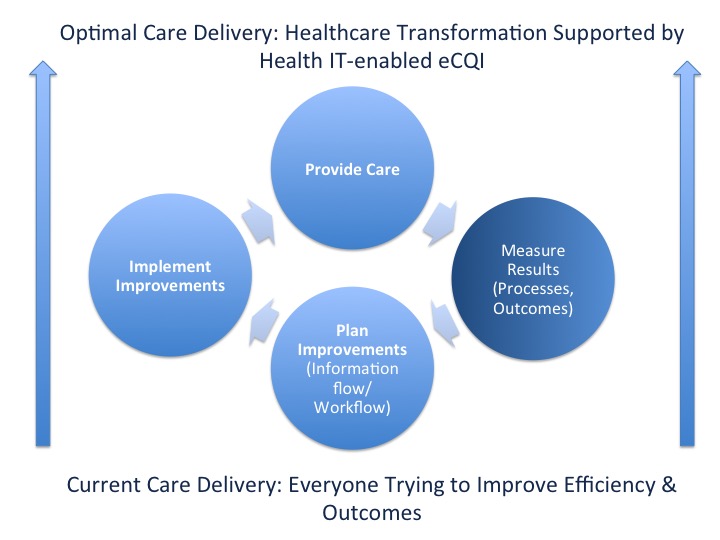
Our topic this week is entitled "The Outcome Model of Quality". I expected to learn more about quality of care in the work force. I feel as though we are learning the same thing over and over but by removing a thin layer at a time. 
The Outcome Model of Quality focuses on the structure, process, and outcomes of quality improvement and quality care. It is the 'how to' behind learning to increase quality of care in the work place. Benchmarks are created and the quality of care is based on those benchmarks. The benchmarks are in line with what the standards are for the industry. They are somewhat averaged out to find a industry 'norm' and then the care for that facility is based off of meeting that benchmark. It is very similar to setting goals and striving to meet those goals but it is an elaborate goal set using the standards of industry.
As a nurse, I want more than anything to help my patient and improve their status. When I start on my shift I am always looking for ways to improve my patient's circumstances. It is tremendously helpful that the hospital in which I work sets their benchmarks high so as I follow the procedures in place, I am doing all I can to help my patient. At the same time, my individual benchmarks are in looking for ways to provide comfort and care, along with the medical side, to improve their stay and help them feel better on a different level. 
I really like anything to do with goal setting or setting a benchmark for improvement. I think if we don't set our heights high enough, we are never moving in the right direction to progress. We can become stagnant and in a constant state of existence, or worse yet, floundering. I think that health care organizations benchmarks should be high. People are going in for help and the industry needs to be ready to provide the best possible care, always looking forward to improvement and continuity. 

Tuesday, February 2, 2016

                                      
 Our topic this week covered the roles of health care individuals. I had expected to learn about the different roles we play as health care workers. We each play our own "titled" role as well as many sub categories. For example, the nurse is active in the clinical care of the patient but also has the role of patient advocate. Also, each interdisciplinary team actively participates in their assigned role. Together, we form a team responsible for excellency in patient care.
                                           
I learned how important our individual roles are in providing quality patient care. If even one of the team is not fulfilling their assigned role, there is a gap in patient coverage. A gap can mean anything from someone not receiving the care they had expected to the extreme of injury or even death. 
The team test we had this week was a great summary of how quality and safety in healthcare is an ever changing and always expanding field. The models such as Kotter's model or Berwick's model of improvement offer great strategies and maps to follow in order to implement effective change. I always appreciate the time spent reflecting as I feel this is where we have the greatest potential to find areas of weakness that can be turned to strengths.
It is so important to me that there are no gaps in my patient's care. There is an advantage to "following" a nurse during orientation or clinical. This perspective makes it a little easier to see what the patient is experiencing. I have been reflecting on that lately and looking for ways to fill the gaps that the patient's may have in their care. It may be that a nurse is so caught up in a routine that they aren't taking a minute to stop, look at the patient in the eye, and really listen to the answers to our questions.
I like checklists like we reviewed in this week's test. I like to have tangible "to do's" that help me play my day. I am learning how to incorporate those checklists with improved patient care. I think we can take the models for quality improvement in healthcare to a refiner level and apply them to our individual patient care on a daily basis.